If a homeowner in New Albany replaces a deck without asking anyone's permission first, and then sells the house two years later, whose problem is the unapproved deck? The seller who built it, or the buyer who now owns it?
In most Central Ohio suburbs that question barely makes sense. Here, it comes with an answer, and the answer is the buyer's problem, because in New Albany the architectural approval on a house is treated less like a permit and more like a piece of the property itself. It is supposed to change hands at closing along with the deed. Most people signing a purchase agreement do not know to ask for it.
The Approval You Can't See From the Curb
New Albany's exterior design standards are not neighborhood tradition. They are law. The city's Design Guidelines and Requirements, or DGRs, govern what the code calls any "environmental change," which is defined broadly enough to include new construction, additions, and even paint. The guidelines carry, in the language of the ordinance itself, the force and effect of law. Before a homeowner alters an exterior feature, the project needs a Certificate of Appropriateness from the city's Architectural Review Board.
That part is public record and searchable in the city's code. What is easy to miss is a second layer, written into individual homeowner association rules rather than city code: the requirement that approval paperwork survive the sale. The New Albany Links Homeowners Association states it plainly in its design guidelines, instructing owners that all approval-related documentation must be kept on file and transferred to the next owner. It is not a suggestion filed away in an HOA newsletter. It is the mechanism by which a cosmetic decision made by one owner becomes a compliance question inherited by whoever buys the house next.
One Address, Three Rulebooks
Here is the part that surprises people who assume "New Albany" means one consistent rulebook. It does not. A property in New Albany can answer to as many as three separate authorities at once: the city's Architectural Review Board under Chapter 1157 of the zoning code, an umbrella body called the New Albany Communities Master Association that oversees shared standards across the city's communities, and then the specific homeowners association attached to that particular section or subdivision, such as the New Albany Links Homeowners Association or the New Albany Country Club HOA.
These layers do not automatically agree with each other, and one does not substitute for another. The Links association says so directly in its own guidelines: municipal approval does not override HOA approval, and HOA approval does not override the city's. A homeowner who gets a city permit for a new patio has not necessarily gotten Links or Country Club approval for the same patio, and vice versa.
The driveway rule is a good example of how confusing this gets in practice. A general renovation guide aimed at New Albany homeowners states that driveways citywide must be black asphalt, with concrete not permitted. That is a reasonable summary of what most of New Albany's neighborhoods require. But the New Albany Country Club HOA's own published design guidelines list brick, dark-colored concrete pavers, and asphalt with rolled-in stone edging as acceptable driveway materials, limited to one 12-foot lane where the driveway meets the street. Two sources, describing the same city, describing different rules, because they are describing different HOAs.
| Governing body | What it actually requires for driveways |
|---|---|
| General citywide renovation guidance | Black asphalt only, concrete not permitted |
| New Albany Country Club HOA design guidelines | Brick, dark concrete pavers, or asphalt with stone edging, limited to a 12-foot lane at the street |
| New Albany Links Homeowners Association | Any driveway change requires prior written ARB approval before signing a contract |
The lesson is not that one source is wrong. It is that the rule that governs a specific lot depends on which HOA that lot sits in, something a buyer cannot determine from a listing photo or a general web search. It has to be confirmed against the guidelines for that specific section.
Georgian by Ordinance, Not by Accident
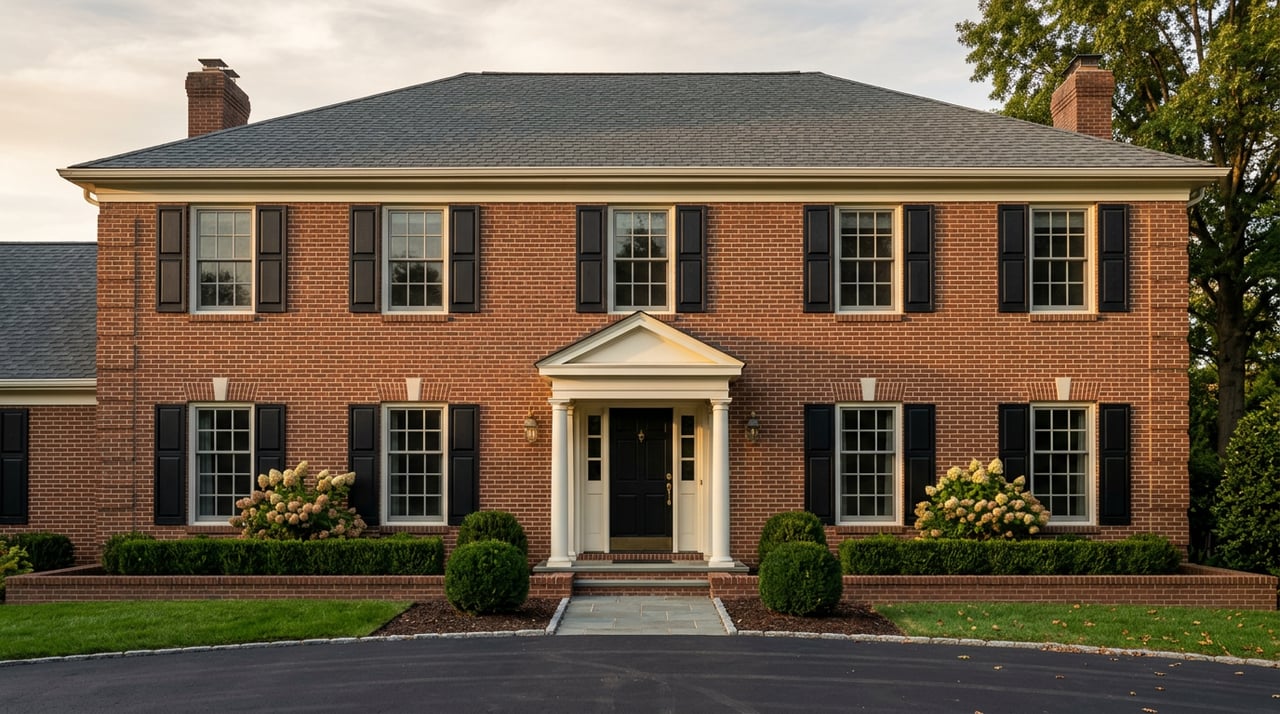
New Albany's visual consistency, the brick facades, the symmetrical elevations, the absence of anything that reads as contemporary, is not a happy accident of a well-heeled market. It is written into the DGRs as a design principle: four-sided architecture is the standard, meaning every elevation, including the sides and rear that neighbors rarely see, gets the same level of detail as the front. The approved architectural vocabulary is narrow by design, drawing from Georgian, Federal, and Colonial Revival precedent, the styles the city's own design guidelines cite as the acceptable American architectural tradition for New Albany.
The city's Architectural Review Board itself was restructured as recently as September 16, 2025, when Ordinance O-37-2025 amended Chapter 1157 and set the board at seven members, up to two of whom may also sit on the Planning Commission. Violations are not treated lightly. Demolishing a structure inside the Architectural Review District without approval carries a fine of up to $10,000 for an individual property owner, and up to $50,000 for a business entity.
Those numbers matter more in New Albany than they would in a lower-priced suburb, because the stakes attached to a compliance mistake scale with the property. New Albany real estate spans from newer construction to multi-million dollar estates near the Country Club, and a five-figure fine reads very differently depending on where a given house sits in that range. It is a real number on a home near the 27-hole Jack Nicklaus course at New Albany Country Club or the 18-hole course at New Albany Links.
What Solar Panels Reveal About Who's Really in Charge
Solar installation is a useful test case for how these layers actually interact, because it involves a state law pulling in one direction and local design authority pulling in another. Ohio Senate Bill 61, effective in September 2022, protects a homeowner's right to install solar panels in a planned community and limits an HOA to imposing only "reasonable restrictions" on size, placement, and appearance. It does not eliminate the HOA's authority. It narrows it.
In practice, the New Albany Links Homeowners Association still requires solar installations to be submitted and approved by its Architectural Review Board before installation, positioned where they are least visible from the street and neighboring properties, and screened to avoid glare or damage to siding. The state law sets a floor on what a homeowner is allowed to do. The HOA still decides how it looks from the street. A buyer who assumes state law means no approval process is needed will be surprised the first time they try to schedule an installer.
Before You Write an Offer, or Sign a Listing Agreement
For a New Albany property, due diligence looks different than it does elsewhere in Central Ohio. Before making an offer, or before listing a home that has had any exterior work done, it is worth confirming a few things that will not show up in a standard disclosure form:
- Which HOA governs the specific lot, since sections within New Albany can carry different rules even for the same category of project
- Whether the seller has the ARB approval file for any past exterior work, since that documentation is supposed to transfer at closing
- Whether any open compliance issues or violation fees are attached to the property, since some HOAs will not accept a new submission on a property with an outstanding violation
- The realistic timeline for a new submission, typically up to 30 days for a decision, plus submission fees that commonly run in the $25 to $50 range depending on project scale
- Whether a planned renovation, such as a driveway replacement or solar installation, needs both a city permit and separate HOA sign-off, since one does not cover the other
A Few Questions Worth Asking
Does the ARB approval actually transfer with the house, or is that just informal practice? It is written into HOA governing documents, not city statute, but it is enforceable the way any HOA covenant is enforceable. The New Albany Links guidelines specifically require the homeowner to maintain and hand off the documentation, which means a buyer who skips this step is trusting that a past owner's paperwork exists and is accurate.
What happens if a home was renovated without approval before I bought it? The obligation to bring the property into compliance, or to pay any associated fee, follows the property rather than the person who did the work. This is exactly why requesting the ARB file before closing matters more here than in a typical suburb without layered design review.
Do I need city approval and HOA approval at the same time, or one after the other? Both are required, and neither substitutes for the other. Getting a city building permit does not mean an HOA's Architectural Review Board has signed off, and getting HOA approval does not remove the need for a city permit where one applies.
New Albany's architectural consistency is one of the reasons buyers pay a premium to live here. The paperwork behind that consistency is part of what you are actually buying, whether or not anyone hands it to you at the closing table. If you are weighing a purchase, a renovation, or a sale in New Albany and want a clear read on what applies to your specific address, Keys + Company can walk through the details with you. Request your free instant home valuation to start the conversation.